


KBK Crane & Steel Gantry Crane for Warehouse in Netherlands
A customer from the Netherlands recently placed an order for a complete lifting solution for a warehouse. The project came from the BMW trade fair in Germany, where we first met the customer in person.
The customer works in the sales and service of forestry and landscaping machinery. He has practical experience with lifting equipment and knew what he needed for his workshop. During the exhibition, we talked about his current workshop, lifting tasks, and equipment requirements. We also took a group photo together, which became the starting point for further communication after the show.
After returning from the exhibition, our team contacted the customer and prepared the first quotation. The project then moved into a much more detailed stage. From the end of last year, we stayed in frequent contact through phone calls and video meetings to work through the details of the warehouse lifting system.
Two KBK Cranes for Different Working Areas
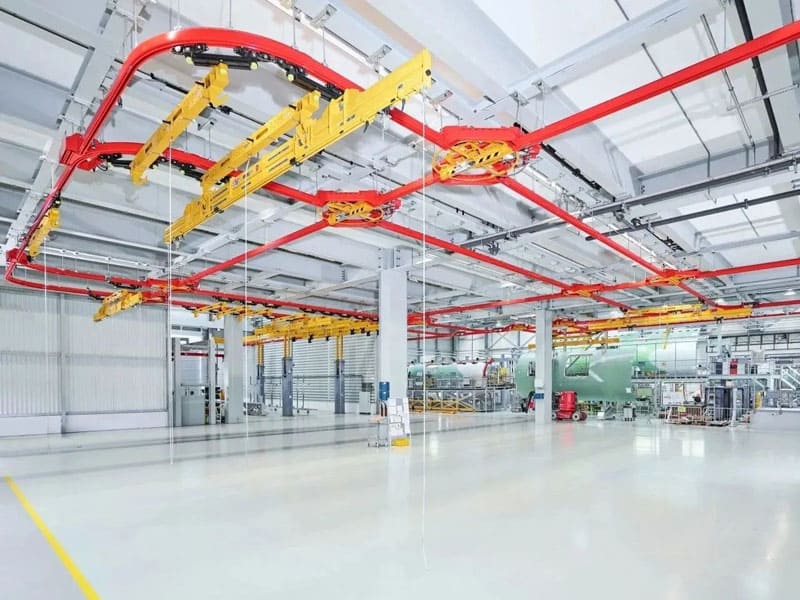
The final project includes two complete KBK crane systems with steel structures.
Both systems are rated at 1 ton, with a 5-meter span and 5-meter lifting height. They use remote control and a 400V, 50Hz, 3-phase power supply. The customer requested RAL 3001 red for all the equipment.
Although the two KBK systems have the same basic configuration, their travel lengths are different. The first system has a 40-meter travel length, while the second covers 30 meters.
Both systems will be fixed to the warehouse ceiling, with a spacing of 5 meters between them. Each KBK system includes four main beams and its corresponding hoist.
This arrangement gives the customer two separate lifting areas while keeping the warehouse floor open for machinery and material handling.
The Steel Gantry Crane Completes the Solution
In addition to the KBK systems, the customer also ordered a 2-ton steel gantry crane.
The gantry crane has a 10-meter span and a 5-meter lifting height. Like the KBK systems, it uses wireless remote control and a 400V, 50Hz, 3-phase power supply. It will also be finished in RAL 3001 red.
The three lifting systems are intended to work together in the warehouse. The overhead KBK systems can cover regular lifting areas, while the steel gantry crane provides another lifting point where a ceiling-mounted system is less convenient.
This combination gives the customer more flexibility without filling the warehouse with fixed lifting structures.
Small Accessories, Carefully Prepared
Some of the customer's requirements were very specific. We included several KBK accessories at no additional cost, including two sets of secondary safety devices, five sets of rail connection bolts, two lifting clamps, and two sliders.
These are not the biggest items in the order, but they matter during installation. Having the required accessories prepared together reduces the chance of missing components when the system is assembled on site.
The customer also needed the equipment to match a clear visual standard, so the same RAL 3001 red color was used throughout the order.

A Project Built Through Continuous Communication
The project took time because the customer wanted to discuss the details carefully. The conversations went well beyond the original quotation.
Phone calls and video meetings allowed us to review the warehouse layout, the KBK installation method, travel lengths, spacing between the two systems, and the steel gantry crane configuration.
The customer's previous experience with workshop lifting equipment also made the discussions very practical. He knew the working conditions he wanted, and our team could respond with specific adjustments instead of starting from a standard package.
After several months of communication and confirmation, the project was finalized.
The equipment will be shipped by sea to Amsterdam, the Netherlands, under CIF terms. The agreed delivery time is 30–35 working days, with 50% payment in advance and 50% before shipment.
This project started with a conversation at a trade fair and grew through many smaller discussions afterward. The final result is not simply a collection of cranes. It is a warehouse lifting system planned around the customer's actual working areas, available space, and daily handling needs.


