


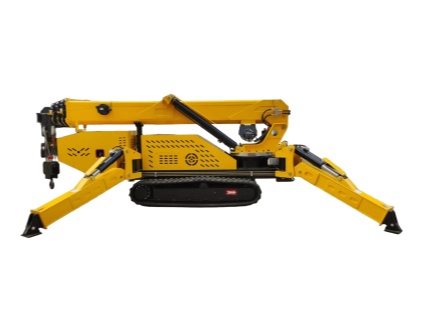
Spider Crane – SS14.0
Email: info@sevencrane.com
Mobile & Skype & WhatsApp: + 86 182 3712 0067
- Model: SS14.0
- Specification: 14.0t×0.5m
- Maximum operating radius: 21.1m×1.2t
- Maximum head above ground:/
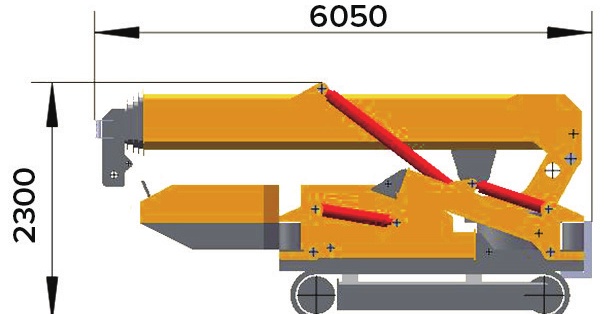
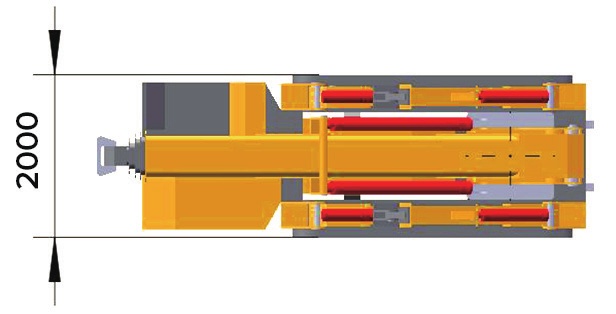
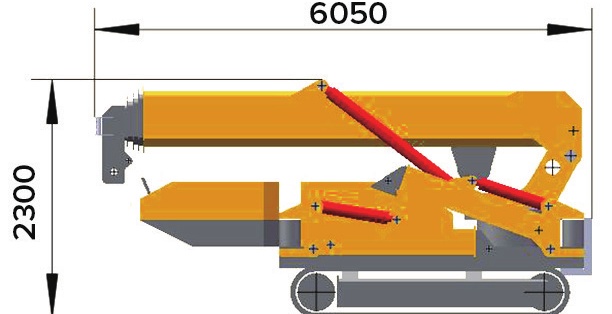
- Vehicle size: 6050mm×2000mm×2300mm
- Vehicle weight:15200kg


Overview
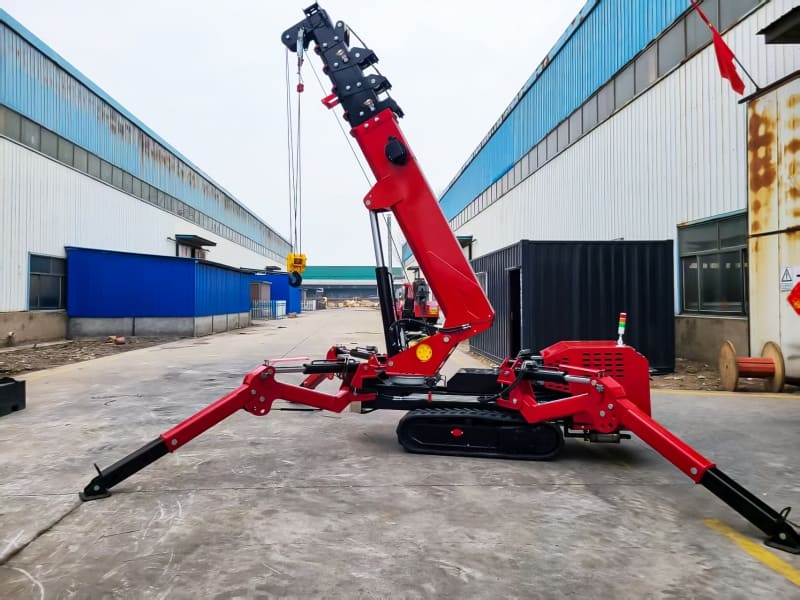
- Despite its small size, the spider crane has a lifting capacity of up to 14 tons, making it perfect for a wide range of jobs. Its powerful boom and extensive reach allow it to lift heavy loads with ease, while its compact size makes it perfect for working in tight spaces.
- The spider crane is also incredibly easy to operate, with its user-friendly controls and intuitive design allowing operators to quickly and effectively carry out tasks with minimal training or experience. It is also very safe to use, with a range of innovative safety features ensuring that operators and bystanders are kept out of harm’s way at all times.
- What’s more, the spider crane is incredibly versatile, with its compact design allowing it to be used in a wide variety of settings, from construction sites and industrial facilities to warehouses, factories, and even domestic settings.
- Overall, the spider crane is a fantastic piece of equipment that offers a range of benefits and advantages. Whether you need to lift heavy loads in tight spaces or require a versatile and powerful crane for a range of different tasks, the spider crane is sure to meet all of your needs and exceed your expectations.
SS14.0 SPECIFICATIONS
| Model | SS14.0 | |
| Specification | 1.2t x 21.1m | |
| Maximum Working Radius | 21.1m x1.2t | |
| Maximum Ground Lifting Height | 22m | |
| Winch Device | Hook Speed | 6.5m/min-12m/min |
| Rope | 11mmx 110m | |
| Telescopic System | Boom Type | Hexagonal fully automatic 5 section |
| Boom Length | 5.9m~21.9m | |
| Telescopic Length/Time | 50sec | |
| Up and Downs | Boom Angle/Time | 0~78° /60sec |
| Slew System | Slew Angle/Time | 0~360° /120sec |
| Outrigger | Outrigger Active Form | Manual rotation, Automatic support |
| Maximum Extended Dimensions | 7400mm x 7000mm x 6000mm | |
| Traction system | Walking Way | Hydraulic motor |
| Walking Speed | Low speed 0-0.8km/h, high speed 0-2km/h | |
| Grade Ability | 20° | |
| Ground Length x Width | 3200mm x400 mm | |
| Diesel Engine | Model | Yuchai |
| Displacement | /L | |
| Rated Output | 85kw | |
| Starting Method | Electric starting | |
| Fuel | diesel | |
| Electric Motor | Model | YE2-180-6 (three-phase AC asynchronous motor) |
| Working Voltage | 380V (Hz50) | |
| Power | 18Kw | |
| Dimension | Length x Width x Height | 6050mm x 2000mm x 2300mm |
| Weight | Vehicle Weight | 15200kg |
| Tank Capacity | 130L | |
| Safety Devices | Torque limiter, anti rollover device, interlock device, hook overwinding device, overload alarm limiter, tri color alarm light, emergency stop button. | |
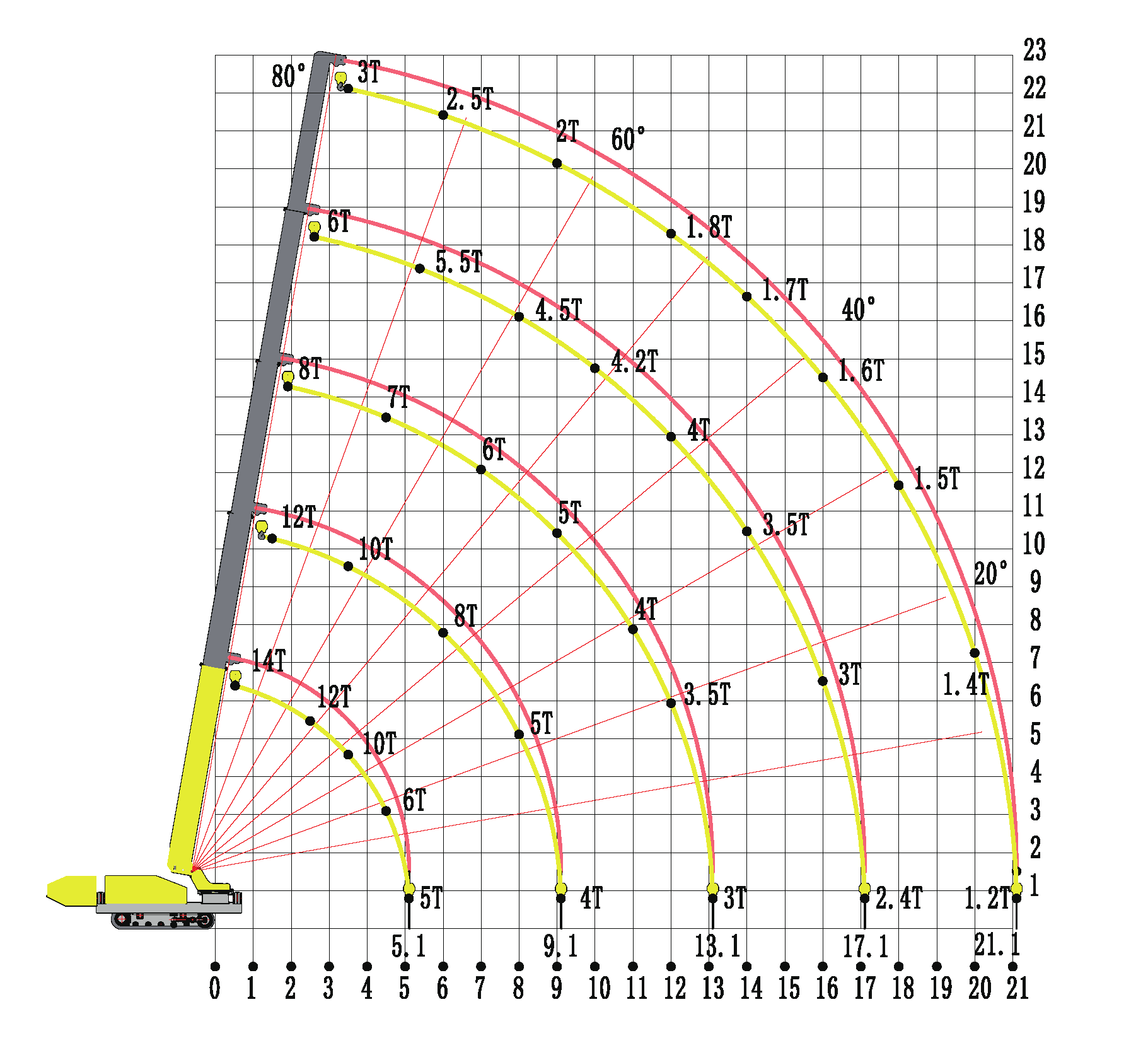
LIFTING TABLE AT MAXIMUM EXTENSION OUTRIGGER
| ≤5.9m | ≤9.9m | ≤13.9m | ≤17.9m | ≤21.9m | |||||
| Working Radius (m) | Rated Load (t) | Working Radius (m) | Rated Load (t) | Working Radius (m) | Rated Load (t) | Working Radius (m) | Rated Load (t) | Working Radius (m) | Rated Load (t) |
| 0.5 | 14 | 1.5 | 12 | 2.0 | 8.0 | 2.5 | 6.0 | 3.5 | 3.0 |
| 2.5 | 12 | 3.5 | 10 | 4.5 | 7.0 | 5.5 | 5.5 | 6.0 | 2.5 |
| 3.5 | 10 | 6.0 | 8.0 | 6.0 | 6.0 | 8.0 | 4.5 | 9.0 | 2.0 |
| 4.5 | 6.0 | 8.0 | 5.0 | 7.0 | 5.0 | 10 | 4.2 | 12 | 1.8 |
| 5.1 | 5.0 | 9.1 | 4.0 | 9.0 | 4.0 | 12 | 4.0 | 14 | 1.7 |
| 11 | 3.5 | 14 | 3.5 | 16 | 1.6 | ||||
| 13.1 | 3.0 | 16 | 3.0 | 18 | 1.5 | ||||
| 17.1 | 2.4 | 20 | 1.4 | ||||||
| 21.1 | 1.2 | ||||||||
Precautions
- The road on which the spider crane travels must be solid and reliable, and should be on a flat and solid ground.
- During the lifting operation, the spider crane cannot be overloaded or tilted.
- When using two cranes for lifting operations, cranes with similar lifting performance should be selected. Unified command should be given during lifting, the movements should be coordinated, the load should be reasonably distributed, and the lifting load of a single crane should not exceed 80% of the allowable load.
- When lifting heavy objects, first test the lifting slightly off the ground to confirm that the heavy objects are hung firmly, and confirm that the stability of the crane and the reliability of the brakes are good before continuing to lift.
- If it is necessary to travel with load, due to the shaking of the fuselage, the crane arm will pitch and fall accordingly, and the amplitude will continue to change. The hoisted heavy objects will also swing due to inertia, forming a tilted lifting. Therefore, the load should be carried out strictly in accordance with the instruction manual, the walking road should be solid and flat, and the heavy objects should be in the front direction of the crane for easy observation and control by the operator.
Maintenance Guide
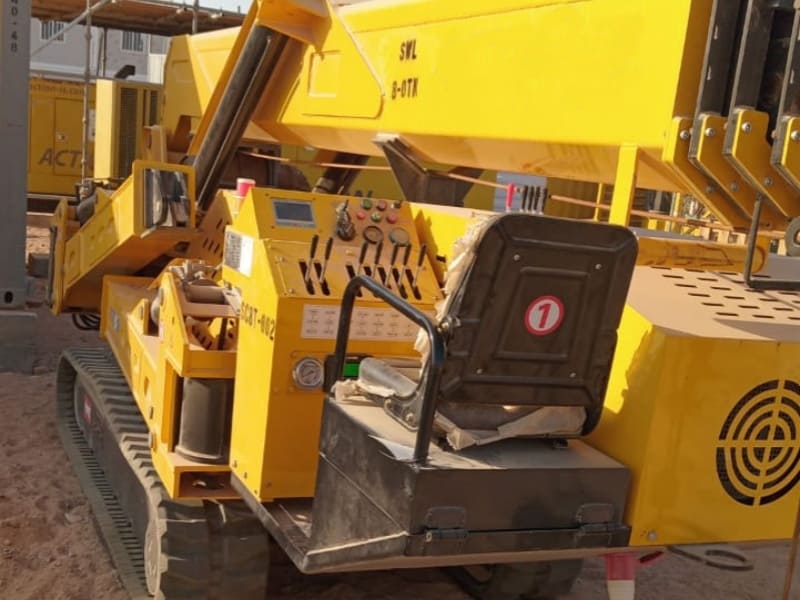
- Check the appearance of the vehicle body, such as the beam, outriggers and other structural parts. If any deformation or cracks are found, stop using the vehicle immediately and contact maintenance.
- In terms of the power system, the engine oil and filter should be replaced in time. Check the air filter regularly, clean or replace it if necessary, to ensure smooth air intake. Replace the spark plug if it is severely worn, and pay attention to the engine belt to avoid breakage. Check the oil level and oil quality of the gearbox, and replace it if the oil quality is poor to ensure the flexibility of the shift mechanism.
- The hydraulic system should not be ignored. Check whether the hydraulic oil level is normal. If the oil becomes black, turbid or has a peculiar smell, replace and clean the system. Carefully check whether the pipes and joints are damaged, leaking, or loose, and repair them in time. Check the hydraulic pump pressure regularly, and check whether the hydraulic cylinder piston rod is scratched or deformed.
- In the electrical system, clean the battery surface, check the electrolyte level and density, clean the electrodes and apply vaseline, check the battery status with a tester, and replace it if the performance deteriorates. Check the circuits thoroughly, repair damage and short circuits, and ensure that plugs and sockets are not loose. Test lights and signal devices to ensure normal operation.
- Safety device maintenance is also critical. Check the safety locks of seat belts, work buckets and outriggers, and test the emergency brake system regularly.
How to choose a suitable spider crane
- First, we need to clarify the work requirements. Different work scenarios have different requirements for the lifting weight, working height and working radius of the spider crane. For example, when working in a small space, the spider crane needs to have flexible steering and a compact body, while also meeting the corresponding lifting tasks. Therefore, accurately determining the required lifting parameters according to the actual working scenario and task is the key first step in choosing a spider crane.
- Secondly, pay attention to the performance of the equipment. A high-quality spider crane should have a stable lifting system to ensure that the cargo rises and falls smoothly during the lifting process and reduce shaking. Its walking system is also crucial, especially in complex terrain conditions, where good passability and stability can ensure the smooth progress of the operation. In addition, the convenience and safety of operation are also performance indicators that cannot be ignored. The advanced control system allows operators to complete various actions more easily, and the complete safety protection devices can effectively reduce the risk of operation.
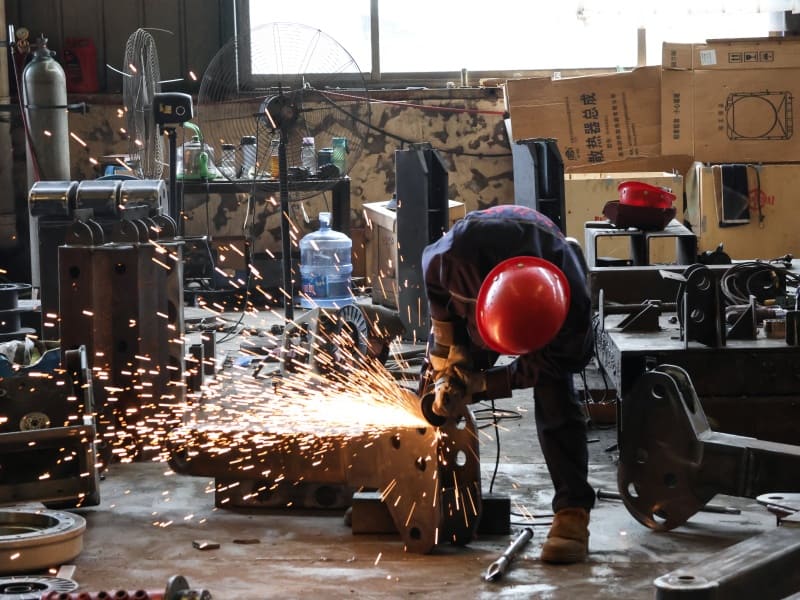
- Furthermore, the quality and reliability of the equipment cannot be ignored. Choosing a well-known brand and a manufacturer with a good reputation can largely guarantee the quality of the equipment. Because these companies usually have advanced production processes and strict quality control systems, the spider cranes they produce perform better in durability and stability, reducing downtime losses caused by equipment failures.

Quality is soul and we sell for future
contact us


