


Indoor gantry crane
Email: info@sevencrane.com
Mobile & Skype & WhatsApp: + 86 182 3712 0067
- Load capacity: 20 tons ~ 45 tons
- Crane span: 12m ~ 35m or customized
- Lifting height: 6m to 18m or customized
- Hoist unit: wire rope hoist or chain hoist
- Working duty: A5, A6, A7
- Power source: Based on your power supply


Overview
What is an Indoor Gantry Crane?
An indoor gantry crane is a lifting system composed of a horizontal girder supported by vertical legs, equipped with a hoist and trolley for moving heavy loads within a confined space. Unlike overhead bridge cranes, it operates at ground level and is often mobile or semi-mobile, making it ideal for warehouses, workshops, and production lines.
Key Components
- Main Girder: The horizontal beam that spans the workspace.
- Legs/End Trucks: Vertical supports with wheels or rails for mobility.
- Hoisting Mechanism: Includes a motor, wire rope/chain, and hook.
- Control System: Pendant, remote, or automated controls.
- Safety Features: Limit switches, overload sensors, and emergency stops.
Why Choose an Indoor Gantry Crane?
- Space Efficiency: Customizable spans and heights fit tight layouts.
- Cost-Effective: Lower installation costs compared to overhead cranes.
- Versatility: Handles loads from 1 ton to 500 tons, depending on design.
Hot Application Scenarios
Indoor gantry cranes are indispensable across industries requiring precise and safe material handling:
A. (Manufacturing)
- Assembly Lines: Lift and position machinery components, engines, or molds.
- Press Shops: Handle metal sheets or stamped parts in automotive plants.
B. (Warehousing & Logistics)
- High-Density Storage: Stack pallets or containers vertically in narrow aisles.
- Loading/Unloading: Transfer goods between trucks and storage racks.
C. (Aerospace)
- Aircraft Assembly: Maneuver fuselage sections or engines with precision.
D. (Automotive Repair)
- Workshop Lifting: Remove and install heavy vehicle parts like transmissions.
Core Differences Between Indoor and Outdoor Gantry Crane


| Feature | Indoor Gantry Crane | Outdoor Gantry Crane |
|---|---|---|
| Structural Design | Lightweight, compact, no weatherproofing | Reinforced with anti-corrosion coatings |
| Mobility | Rubber tires or rail wheels for smooth floors | Heavy-duty wheels for gravel/uneven terrain |
| Power Supply | Fixed power (cable reels, conductor bars) | Diesel generators or hybrid systems |
| Safety Features | Focus on collision avoidance and low noise | Wind resistance, lightning protection |
| Load Capacity | Up to 500 tons (double girder) | Often higher (e.g., port cranes up to 1,000 tons) |
Impact of Indoor Space Constraints on Design
A. (Headroom Optimization)
- Challenge: Limited vertical space between the floor and ceiling.
- Solution: Low-profile girder designs (e.g., single girder) maximize lifting height.
B. (Span Customization)
- Challenge: Avoiding collisions with columns, racks, or machinery.
- Solution: Modular girders tailored to warehouse column spacing (e.g., 10–30 meters).
C. (Aisle Accessibility)
- Challenge: Navigating narrow pathways in high-density storage.
- Solution: Rubber-tired cranes with compact turning radii.
Material Selection for Indoor Environments
A. (Corrosion Resistance)
- Requirement: Moderate protection against humidity or chemical vapors.
- Materials: Epoxy-coated steel or powder-coated aluminum.
B. (Noise Reduction)
- Requirement: Minimize operational noise in workshops or labs.
- Materials: Polyurethane wheels, vibration-dampened motors.
C. (Dust Prevention)
- Requirement: Protect electrical components in dusty environments.
- Materials: IP55-rated enclosures for motors and control panels.
Pre-Installation Site Planning
A. (Floor Load Analysis)
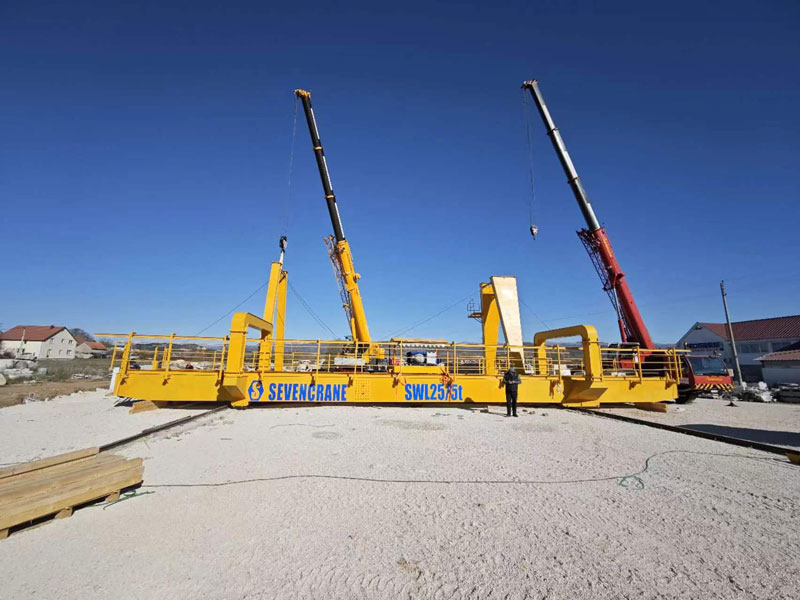
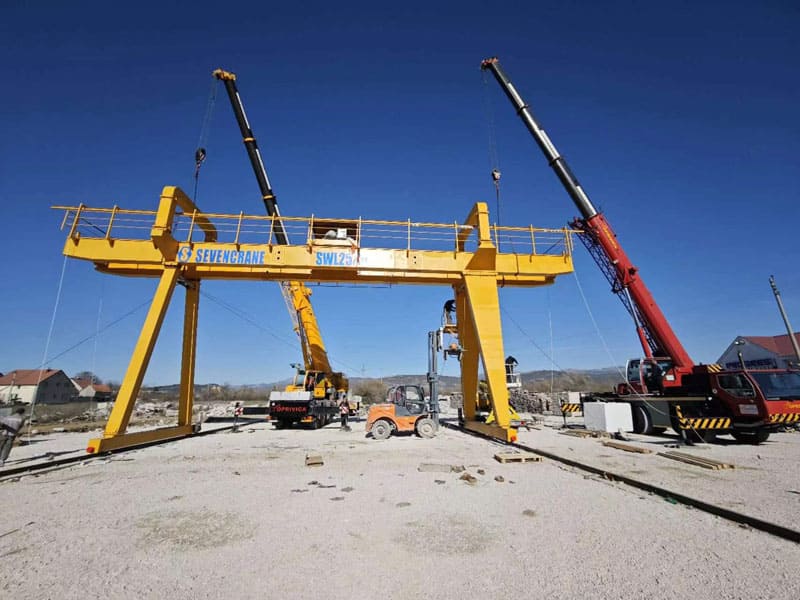
- Step 1: Verify floor strength (≥5 tons/m² for standard cranes).
- Step 2: Reinforce concrete floors with steel plates if necessary.
B. (Pathway Design)
- Clearance: Ensure 0.5m gap between crane and obstacles.
- Traffic Flow: Separate crane zones from forklift or AGV routes.
C. (Power & Lighting)
- Power Source: Install conductor bars or cable reels near workstations.
- Lighting: Add LED lights to the crane for shadow-free operations.
Maintenance & Troubleshooting
A. (Daily Checks)
- Inspect wire ropes for fraying or corrosion.
- Test emergency stop buttons and limit switches.
- Clean debris from wheels and rails.
B. (Monthly Tasks)
- Lubricate gears, bearings, and trolley tracks.
- Check brake alignment and pad thickness.
- Calibrate overload sensors.
C. (Troubleshooting)
Issue 1: Crane drifts during operation.
Cause: Worn brake pads or misaligned wheels.
Fix: Replace pads or adjust wheel alignment.
Issue 2: Hoist motor overheats.
Cause: Overloading or blocked ventilation.
Fix: Reduce load or clean motor vents.
Issue 3: Control pendant unresponsive.
Cause: Loose wiring or dead battery (wireless models).
Fix: Reconnect cables or recharge battery.

Quality is soul and we sell for future
contact us


