


A Straddle Carrier Is Not Just for Containers
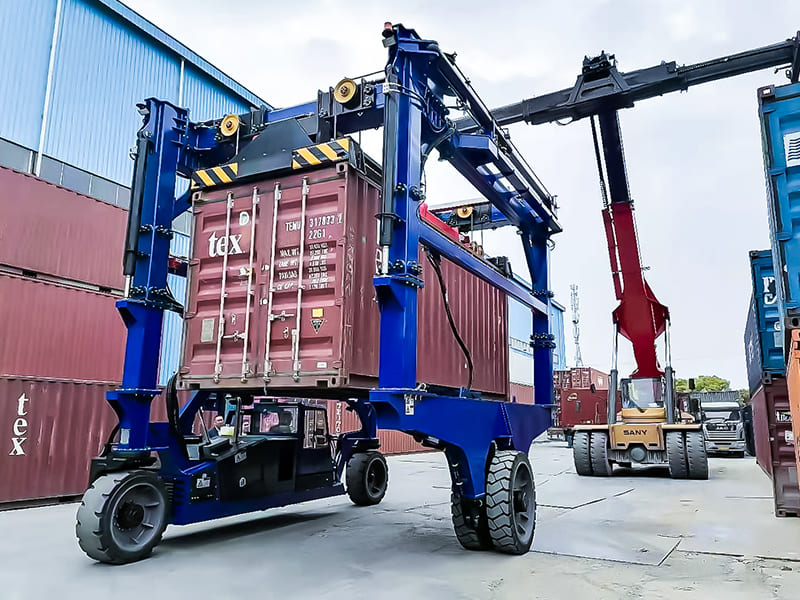
When people hear Straddle Carrier, they often think of container terminals. That makes sense. Container straddle carriers are widely used in ports, intermodal terminals, logistics yards, and transfer stations. They can pick up, move, and stack containers with one machine.
But the basic idea of a Straddle Carrier goes much further than containers.
At its core, a straddle carrier is a gantry-type handling machine. It travels over the load instead of simply pulling it from one point to another. With the right lifting attachment, the same basic structure can be adapted for other materials and working conditions.
Why Container Straddle Carriers Are So Flexible
A typical container straddle carrier combines a gantry frame, drive and transmission system, hydraulic system, electrical controls, steering and braking systems, and a lifting spreader. This lets it handle several jobs in the same operating area.
Compared with a container trailer or an automated guided vehicle, it has more freedom during loading and unloading. It can pick up a container by itself and move it directly to another position.
Compared with an RTG or RMG, it is not tied to a fixed rail system. The machine can change direction and move around the yard as required.
Depending on the frame height and working purpose, container straddle carriers are generally used as stacking or transport models. Stacking types can handle containers at multiple tiers. Transport types are normally designed for short-distance horizontal movement and lower stacking requirements.
The Same Idea Can Handle Other Loads
The interesting part starts when the container spreader is replaced with another lifting device.
A Straddle Carrier can be designed to handle long beams, steel products, machinery, precast components, or other loads that need to be moved horizontally. The frame and running gear are then designed around the required working load.
The lifting attachment can also be changed. Instead of a container spreader, the machine may use a dedicated lifting tool designed for a specific product.
This approach is useful for industrial yards where forklifts are not suitable for the load or where a traditional crane cannot provide enough mobility.
Single-Gantry and Double-Gantry Designs
Not every straddle carrier needs two full gantry frames.
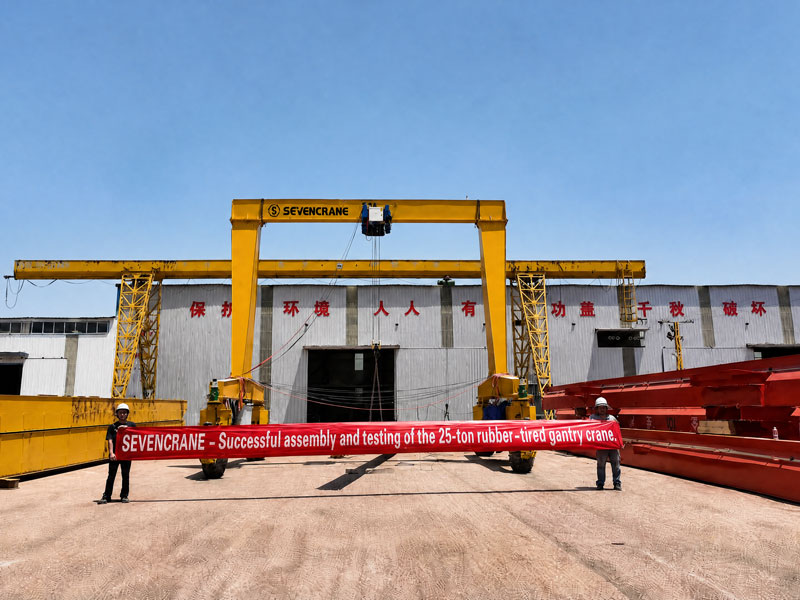
A single-gantry handling machine can be designed for lighter loads with a concentrated center of gravity and relatively regular shapes. Its stability is different from a double-gantry structure, so the load and working conditions need to be considered carefully.
For larger or heavier loads, a double-gantry design can provide a more stable support structure. Both types can work as individual machines or operate together as a pair.
They can also be combined with a tractor or other transport equipment when the material needs to be moved through a larger site.
The Frame and Wheels Can Be Customized
The gantry does not always need to be a standard rectangular frame. An irregular or special-shaped frame can be designed when the site has height restrictions, obstacles, or unusual load dimensions.
The wheel arrangement can also be symmetrical or offset according to the layout. Steering may be designed for the required travel direction and turning conditions.
This is where a Straddle Carrier becomes a real industrial handling solution instead of simply a container machine.
A construction site may need to move long structural members. A warehouse may need to reposition heavy machinery. A storage yard may have no suitable fixed runway. In each case, the machine can be developed around the load and the site.
The main advantage is not one particular attachment or frame shape. It is the ability to combine a gantry structure, flexible running system, and purpose-built lifting equipment into one machine. That is why a Straddle Carrier can find applications well beyond container handling.
